
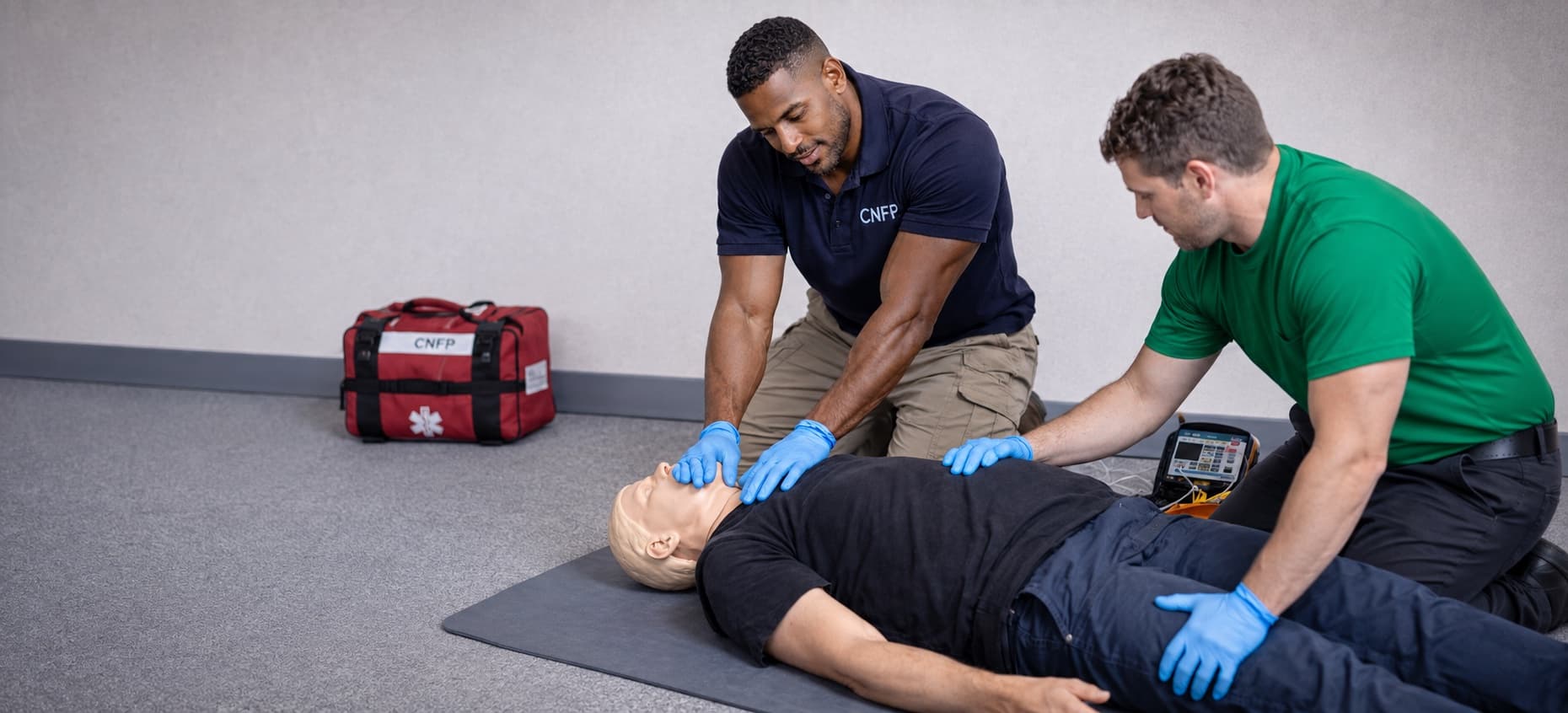
Course objectives
- Understand the role of the Workplace First Aider (SST) within the company's prevention organisation
- Provide appropriate protection in the event of a workplace accident
- Examine the casualty in order to identify a life-threatening emergency
- Alert or have someone alert the emergency services, passing on the necessary information
- Give the casualty appropriate first aid until specialist emergency services take over
- Contribute to the prevention of occupational risks by identifying dangerous situations
Who it is for
Audience
All employees, staff, supervisors or managers; Personnel exposed or not exposed to specific risks
Prerequisites
Spoken and written understanding of French; Physical ability to perform first-aid techniques
Format
Face-to-face training, in our rooms in Jarry or directly on your premises. Alternation of theoretical input and practical scenarios, using the centre's training equipment. People with disabilities are invited to inform us of their adaptation needs when registering.
Lead time
Registration is possible up to 48 hours before a scheduled session, subject to availability. For a session organised on your premises, allow approximately 15 days between your request and delivery.
Course content
Sequence 1 – The SST framework and prevention
- Presentation of the SST scheme and the course objectives
- Role, duties and responsibilities of the Workplace First Aider (SST)
- Principles of occupational risk prevention and the SST's place within it
Sequence 2 – Identifying risks and protecting
- Identification of hazards and risk situations in the company
- Analysis of a workplace accident situation
- Implementation of protective actions in the face of danger
Sequence 3 – Examining the casualty and alerting
- Examination of the casualty and checking for signs of life-threatening distress
- Prioritising actions
- Organising the alert and passing on information to the emergency services
Sequence 4 – First aid: emergency techniques (1)
- What to do in the event of severe bleeding
- What to do in the event of choking
- What to do when someone feels unwell
Sequence 5 – First aid: emergency techniques (2)
- What to do in the event of loss of consciousness
- What to do in the event of cardiac arrest
- Use of the automated external defibrillator, AED (defibrillator)
Sequence 6 – Practical application and prevention
- Practical scenarios and real-life cases related to the company
- Analysis of accidents and proposal of prevention actions
- Assessment of SST skills and course review
Teaching team
The teaching team of the Centre National de Formation et de Prévention (CNFP) is made up of expert trainers and instructors with solid field experience and a thorough command of the regulatory frameworks applicable to their areas of expertise.
CNFP instructors are selected for their technical competence, their ability to pass on practical knowledge and their understanding of the professional realities of the trainees they teach.
The teaching team is committed to an ongoing process of improving practices, monitoring regulations and adapting content in order to ensure the quality, relevance and effectiveness of training activities.
Monitoring and assessment
Results indicators are monitored at the end of each training session and cover in particular:
– The trainee attendance rate
– The SST certification pass rate
– The trainee satisfaction rate
– The number of certificates issued
These indicators are monitored and analysed with a view to the continuous improvement of training activities.
Technical and teaching resources
Training materials in line with the INRS SST framework
First-aid manikins (adult, child)
Training AED (defibrillator)
Scenario and simulation equipment
Educational videos and visual aids
Documents given to trainees at the end of the course
Certification
Assessment
Attendance sheets signed for each half-day
Monitoring of attendance throughout the course
Formative assessments during practical scenarios
Certification assessment in line with the SST framework
Issue of a certificate of completion
Collection of trainee satisfaction feedback
Certification
SST Certificate
Certifying body
INRS
Quality and results
Indicators specific to this course, as at 10 September 2026: 16 satisfaction reviews collected at the end of this course, average score of 9.8/10; assessment pass rate of 100.0% (16 passes out of 16 trainees assessed).
Across the centre, from 30 January to 10 September 2026: 112 satisfaction reviews collected from trainees, average score of 9.30/10, of which 92.9% of scores were greater than or equal to 8/10; assessment pass rate of 97.3% (181 passes out of 186 trainees assessed).
These indicators are updated after each session and provided on request.
Accessibility
CNFP considers every adaptation request in order to facilitate access to training for people with disabilities. A preliminary discussion makes it possible to assess needs and to consider, where possible, adapted arrangements.
Our disability lead reviews every request for adjustments: handicap@cnfp.fr
Interested in this course?
Session at your premises, dates to suit you, group size adapted.