
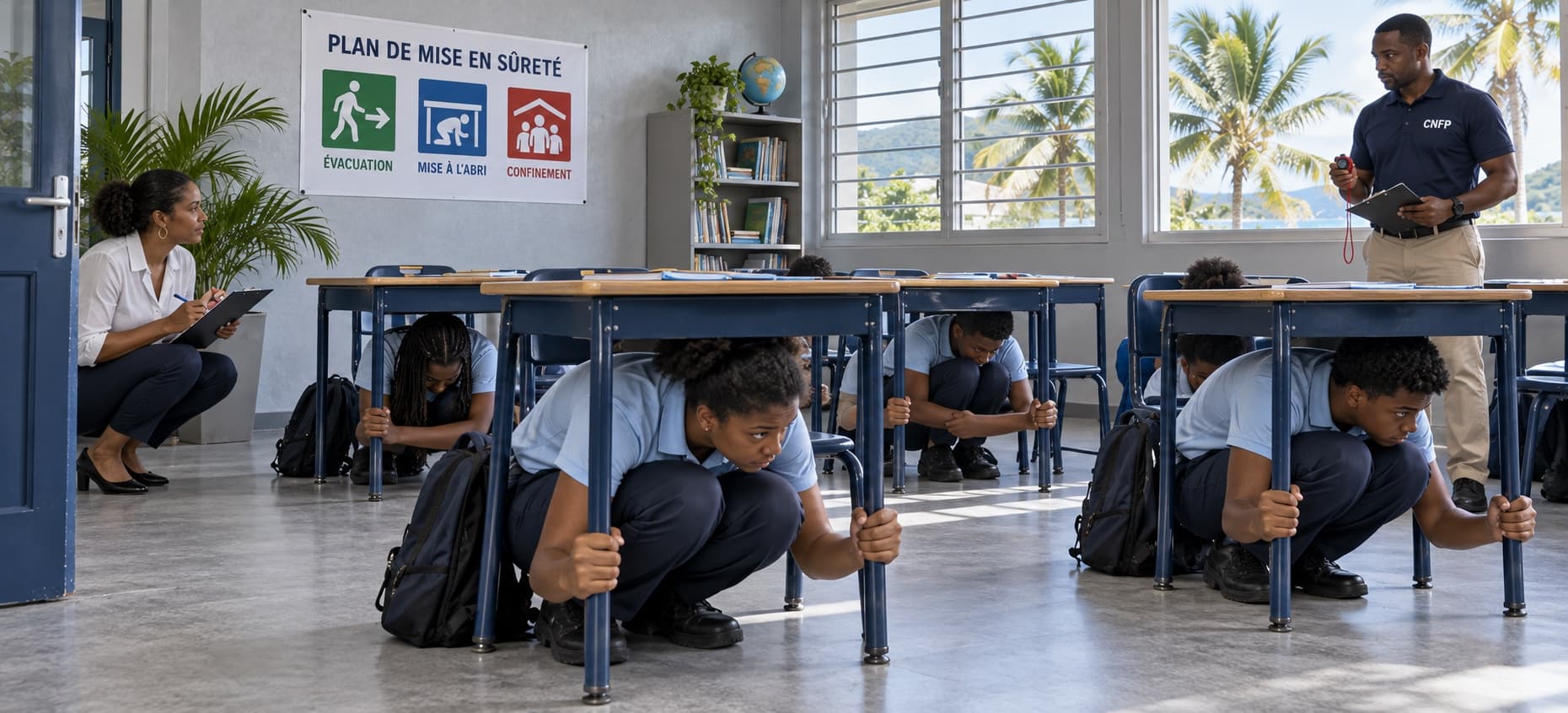
Course objectives
- Identify the major risks of the territory and their effects on the establishment
- Explain the framework of the unified PPMS and the role of each person
- Choose the appropriate response according to the situation: evacuate, take shelter, shelter in place, escape or hide
- Organise safety measures: crisis unit, roles, alert and communication
- Prepare, conduct and debrief a safety drill
Who it is for
Audience
Heads of establishments, school head teachers and their deputies ; Senior education advisers ; Teaching, administrative and technical staff ; Managers of nurseries and group settings for minors ; Managers of premises open to the public ; Safety officers
Prerequisites
No prerequisites. Participants are invited to bring their establishment's safety plan, if one exists.
Format
Face-to-face training, in our training rooms in Jarry or directly on your premises. A combination of theoretical input and practical scenarios, using the centre's training equipment. People with disabilities are invited to inform us of any adaptation needs when registering.
Lead time
Registration is possible up to 48 hours before a scheduled session, subject to availability. For a session organised on your premises, allow around 15 days between your request and delivery.
Course content
Sequence 1 – The major risks of the territory
- Cyclone, earthquake, tsunami, flood, ground movement, volcanic activity, technological risks
- What each risk does to a building and its occupants
- Weather warnings and alerts: Météo-France, prefecture, municipality
- Reference documents: municipal document on major risks (DICRIM), municipal safeguarding plan
Sequence 2 – The unified specific safety plan
- The framework: circular of 8 June 2023, public establishments and private schools under contract with the State, timetable and annual drills
- A single plan for major risks and the risks of intrusion or terrorist attack
- Content of the plan: crisis directory, shelter zones, role sheets, equipment
- Nurseries and settings for minors: the safety protocol, consistency with school time
- Coordination with the municipality, emergency services and families
Sequence 3 – The correct responses
- Evacuate, take shelter, shelter in place: when and how
- Earthquake: protect yourself during the shaking, then evacuate
- Tsunami: move to higher ground ; cyclone: before, during, after
- Intrusion: escape or hide, raise the alert
- Vulnerable groups and people with disabilities
Sequence 4 – Organising and practising safety measures
- The crisis unit and allocation of roles
- Internal alert, communication with families and emergency services
- Preparing, conducting and debriefing a drill
- Workshop: review of the participants' establishment plan and improvement plan
Teaching team
The teaching team of the Centre National de Formation et de Prévention (CNFP) is made up of expert trainers and speakers with solid field experience and a thorough command of the regulatory frameworks applicable to their areas of expertise.
CNFP's speakers are selected for their technical competence, their ability to pass on operational knowledge and their understanding of the professional realities of the trainees.
The teaching team is committed to the continuous improvement of practice, regulatory monitoring and the adaptation of content in order to guarantee the quality, relevance and effectiveness of its training.
Monitoring and assessment
Participant satisfaction rate
Attendance and course completion rate
Pass rate in final assessments
Level of achievement of learning objectives
These indicators are used to assess the effectiveness of the training and to feed into the continuous improvement approach.
Technical and teaching resources
Projected training materials
Map of the major risks of the territory
Quick-reference sheets for each type of risk given to participants
Drill template and observation grid
Case studies and work on the establishment's plan
Certification
Assessment
Attendance sheets signed every half-day
Monitoring of participants' attendance
Formative assessments at each sequence (centre's assessment grids)
Assessment of learning at the end of the training: practical scenario or case study assessed using a grid
Collection of satisfaction feedback
Issue of a certificate of completion
Analysis of feedback as part of a continuous improvement approach
Certification
This training does not lead to a professional certification. A CNFP training certificate is issued.
Quality and results
New course: the first indicators specific to this course will be published after the first sessions.Centre-wide, from 30 January to 10 September 2026: 112 satisfaction responses collected from trainees, average score of 9.30/10, with 92.9% of scores at or above 8/10 ; assessment pass rate of 97.3% (181 passes out of 186 trainees assessed).These indicators are updated after each session and provided on request.
Accessibility
CNFP considers every request for adaptation in order to facilitate access to training for people with disabilities. A preliminary discussion makes it possible to assess needs and to consider, where possible, adapted arrangements.
Our disability lead reviews every request for adjustments: handicap@cnfp.fr
Interested in this course?
Session at your premises, dates to suit you, group size adapted.