
Course objectives
- Intervene as part of an organised team, under the direction of a team leader
- Immobilise a casualty with a limb or spinal injury
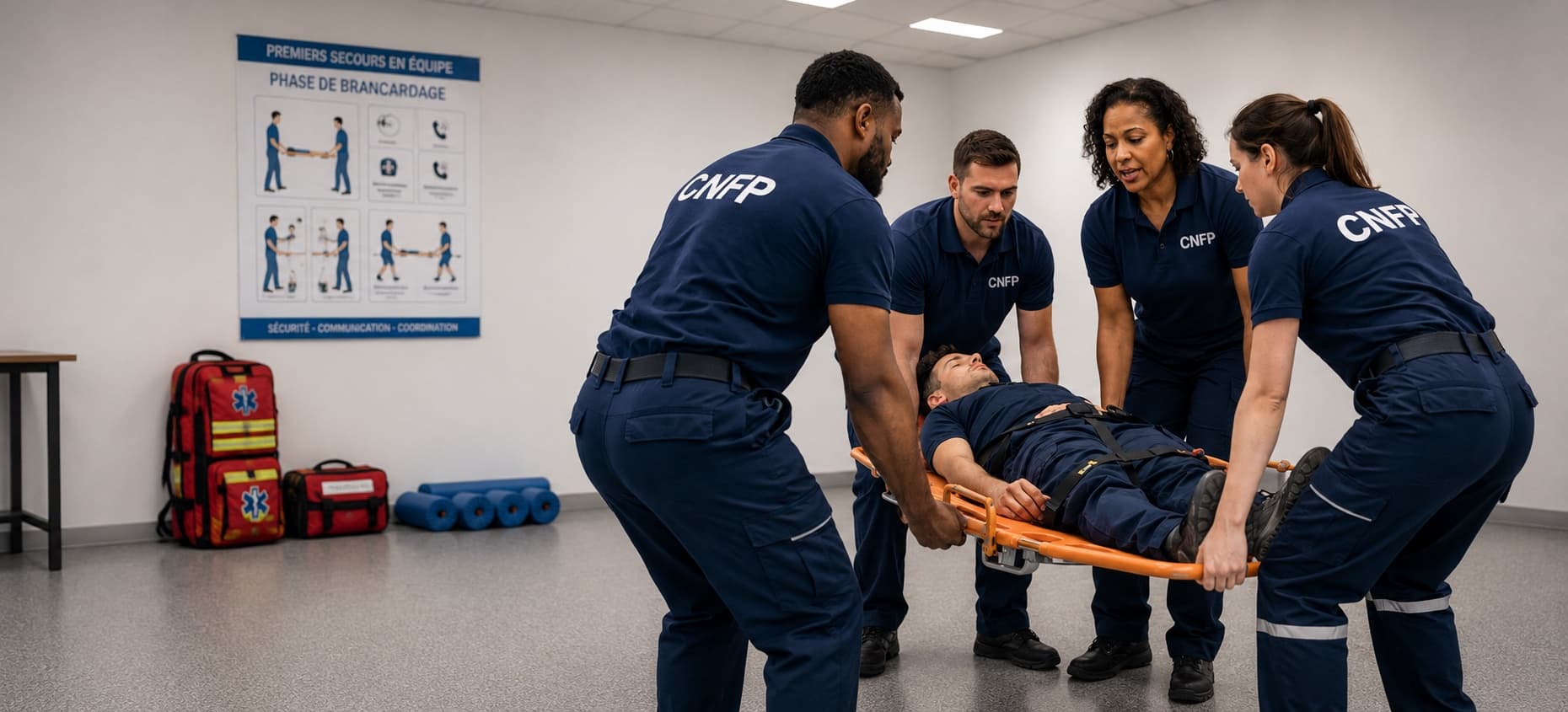
- Carry out a lift and stretcher carry with several team members, safely
- Manage a casualty with an environmental or circumstantial condition
- Adapt one's approach when faced with psychological distress or unusual behaviour
- Ensure coordination and handover with medical teams
- Apply hygiene and asepsis rules during the intervention
Who it is for
Audience
First aid team members holding PSE1 team first aid; Members of approved civil protection associations; Personnel deployed on pre-planned first aid cover arrangements; Local authority staff and security personnel required to intervene as part of a team
Prerequisites
Hold PSE1 team first aid and be up to date with continuing training; Be at least 16 years old (parental consent for minors); Physical fitness for practical scenarios, lifting and stretcher carrying
Format
Face-to-face training, in our training rooms in Jarry or directly on your premises. A combination of theory and practical scenarios, using the centre's training equipment. People with disabilities are invited to inform us of their adaptation needs when registering.
Lead time
Registration is possible up to 48 hours before a scheduled session, subject to availability. For a session held on your premises, allow around 15 days between your request and delivery.
Course content
Module 1 — The first aid team member and their team
- Role and responsibilities of the first aid team member within the team
- Organisation of a first aid team and direction by the team leader
- Regulatory framework for pre-planned first aid cover arrangements
Module 2 — Hygiene and asepsis
- Infection risk and modes of transmission of pathogens
- Standard precautions and protection of the responder
- Equipment maintenance and disposal of clinical waste
Module 3 — Assessments and handover to medical teams
- Scene assessment, life-threatening emergency assessment and secondary assessment
- Monitoring the casualty and tracking changes in vital signs
- Structured handover of the assessment and hand-off to medical teams
Module 4 — Environmental and circumstantial conditions
- Effects of heat, cold and immersion
- Poisoning, stings and bites
- Electrical accidents and blast effects
Module 5 — Psychological distress and unusual behaviour
- Recognising psychological distress or unusual behaviour
- Appropriate communication and building the casualty's trust
- Action to take and limits of the first aider's intervention
Module 6 — Limb and spinal injuries
- Recognising a limb or spinal injury
- Holding the head and maintaining head-neck-trunk alignment
- Action to take while awaiting the lift
Module 7 — Immobilisation
- Immobilisation equipment and indications for use
- Immobilising a limb and applying a splint
- Spinal immobilisation: cervical collar, long spine board, vacuum mattress
Module 8 — Lifting and stretcher carrying
- Lifting techniques with several team members
- Safe carrying and stretcher carrying
- Positioning, securing and monitoring during transport
Module 9 — Multiple-casualty situations
- Organising the response to multiple casualties
- Triage, prioritisation and identification of casualties
- The team member's place in the response and passing on information
Module 10 — Operational scenarios
- Practical cases in an organised team
- Coordination, communication and stress management
- Continuous assessment and validation of competences
Teaching team
The teaching team of the Centre National de Formation et de Prévention (CNFP) is made up of expert trainers and practitioners with solid field experience and a thorough command of the regulatory frameworks applicable to their areas of expertise.
CNFP practitioners are selected for their technical competence, their ability to pass on operational knowledge and their understanding of the professional realities of the trainees.
The teaching team is committed to an ongoing process of improving practices, monitoring regulations and adapting content in order to guarantee the quality, relevance and effectiveness of its training courses.
Monitoring and assessment
The course's results indicators are monitored through the attendance rate, the competence validation rate and trainee satisfaction levels, making it possible to assess teaching effectiveness and to place the course within a continuous improvement process.
Technical and teaching resources
First aid manikins (adult, child, infant)
Training defibrillator
Full first aid equipment (oxygen, immobilisation…)
Training materials compliant with national frameworks
Simulation scenarios
Certification
Assessment
Attendance sheets
Continuous assessment during practical exercises
Observation of technical skills
Validation of competences by the authorised trainer
Certification
The PSE2 team first aid certificate of competence is issued by a partner approved civil protection association, in accordance with the arrêté du 14 novembre 2007, as amended. To maintain it, a minimum of 6 hours of continuing training is required each year (arrêté du 21 décembre 2020).
Quality and results
New course: the first indicators specific to this course will be published after the first sessions.
Centre-wide, from 30 January to 10 September 2026: 112 satisfaction reviews collected from trainees, average score of 9.30/10, with 92.9% of scores at or above 8/10; assessment pass rate of 97.3% (181 passes out of 186 trainees assessed).
These indicators are updated after each session and available on request.
Accessibility
CNFP considers every adaptation request in order to facilitate access to training for people with disabilities. A preliminary discussion makes it possible to assess needs and, where possible, consider suitable arrangements.
Our disability lead reviews every request for adjustments: handicap@cnfp.fr
Interested in this course?
Session at your premises, dates to suit you, group size adapted.