
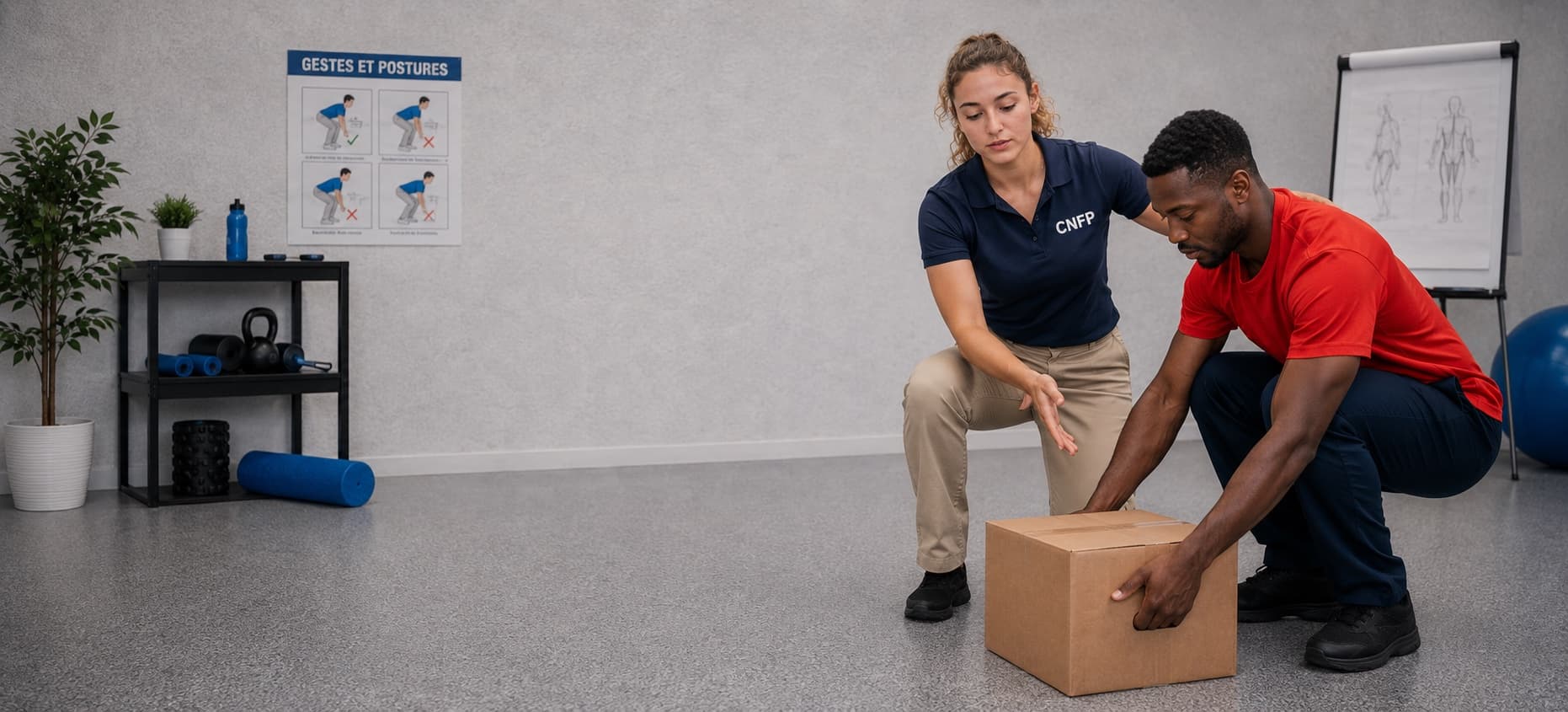
Course objectives
- Identify work situations that generate postural risks and musculoskeletal disorders
- Understand the biomechanical principles of the human body as applied to professional activity
- Apply the fundamental rules of safe manual handling
- Adapt one's behaviour and postures to one's workstation
- Contribute actively to the prevention of workplace accidents and MSDs within one's working environment
Who it is for
Audience
Companies in all sectors of activity ; Local authorities and public bodies ; Establishments open to the public (ERP) ; Associations and social and solidarity economy organisations ; Training organisations and apprentice training centres ; Self-employed workers and independent professionals
Prerequisites
No prerequisites are required to attend the Manual Handling – MSD Prevention course. ; The course is open to everyone, whatever their level of knowledge or sector of activity.
Format
Face-to-face training, in our rooms in Jarry or directly on your premises. A combination of theoretical input and practical exercises, using the centre's teaching equipment. People with disabilities are invited to let us know their adaptation needs when registering.
Lead time
Registration is possible up to 48 hours before a scheduled session, subject to availability. For a session organised on your premises, allow approximately 15 days between your request and delivery.
Course content
Sequence 1 – Awareness of MSDs and prevention issues
- Workplace accidents and occupational diseases
- Definition of musculoskeletal disorders (MSDs)
- Human, organisational and regulatory issues
Sequence 2 – Basics of anatomy and biomechanics
- How the human body works
- Role of the spine
- Muscles, joints and at-risk areas of the body
Sequence 3 – Analysis of at-risk work situations
- Awkward postures
- Repetitive movements
- Manual handling of loads
- Prolonged static positions
Sequence 4 – Fundamental principles of manual handling
- Economy of effort
- Safe posture
- Positioning of the back and the upper and lower limbs
- Use of body weight
Sequence 5 – Adapting the workstation
- Principles of ergonomics
- Workstation layout
- Organisation of space and equipment
Sequence 6 – Everyday prevention and good practice
- Warm-ups and stretching
- Alternating tasks
- Recognising the body's warning signs
- Adopting lasting preventive behaviours
Teaching team
The course is designed and delivered by a teaching team made up of professional trainers specialising in risk prevention and occupational health and safety.
The trainers have solid field experience and teaching skills suited to face-to-face training. They actively support participants, encouraging discussion, practical demonstrations and the adaptation of content to the professional situations encountered.
Monitoring and assessment
CNFP implements a quality approach aimed at the continuous improvement of its training activities.
The results indicators monitored for this course include in particular:
– the participation and attendance rate of participants,
– the level of achievement of the learning objectives observed during practical exercises,
– the participant satisfaction rate collected at the end of the course,
– the number of training certificates issued.
Feedback from participants and clients is analysed in order to adapt the content, teaching methods and organisation of the courses with a view to continuous improvement.
Technical and teaching resources
Teaching materials provided by the trainer
Projected presentations and visual aids
Teaching documents given to participants (paper or digital format)
Case studies and examples drawn from real professional situations
Practical demonstrations and supervised exercises
Interactive discussions between the trainer and participants
Certificate of completion issued online
Certification
Assessment
Attendance sheets signed for each half-day
Monitoring of participants' attendance throughout the course
Formative assessments during discussions and practical exercises
Assessment of learning at the end of the course
Collection of participants' satisfaction evaluations
Issue of a certificate of completion
Analysis of feedback for the continuous improvement of training activities
Quality and results
New course: the first indicators specific to this course will be published after the first sessions.
Across the centre, from 30 January to 10 September 2026: 112 satisfaction reviews collected from trainees, average score of 9.30/10, with 92.9% of scores at or above 8/10; assessment pass rate of 97.3% (181 passes out of 186 trainees assessed).
These indicators are updated after each session and provided on request.
Accessibility
The Manual Handling – Prevention of Musculoskeletal Disorders course is accessible to people with disabilities.
A preliminary discussion is always offered in order to identify specific needs and, where possible, to put in place suitable teaching adaptations.
Our disability lead reviews every request for adjustments: handicap@cnfp.fr
Interested in this course?
Session at your premises, dates to suit you, group size adapted.