
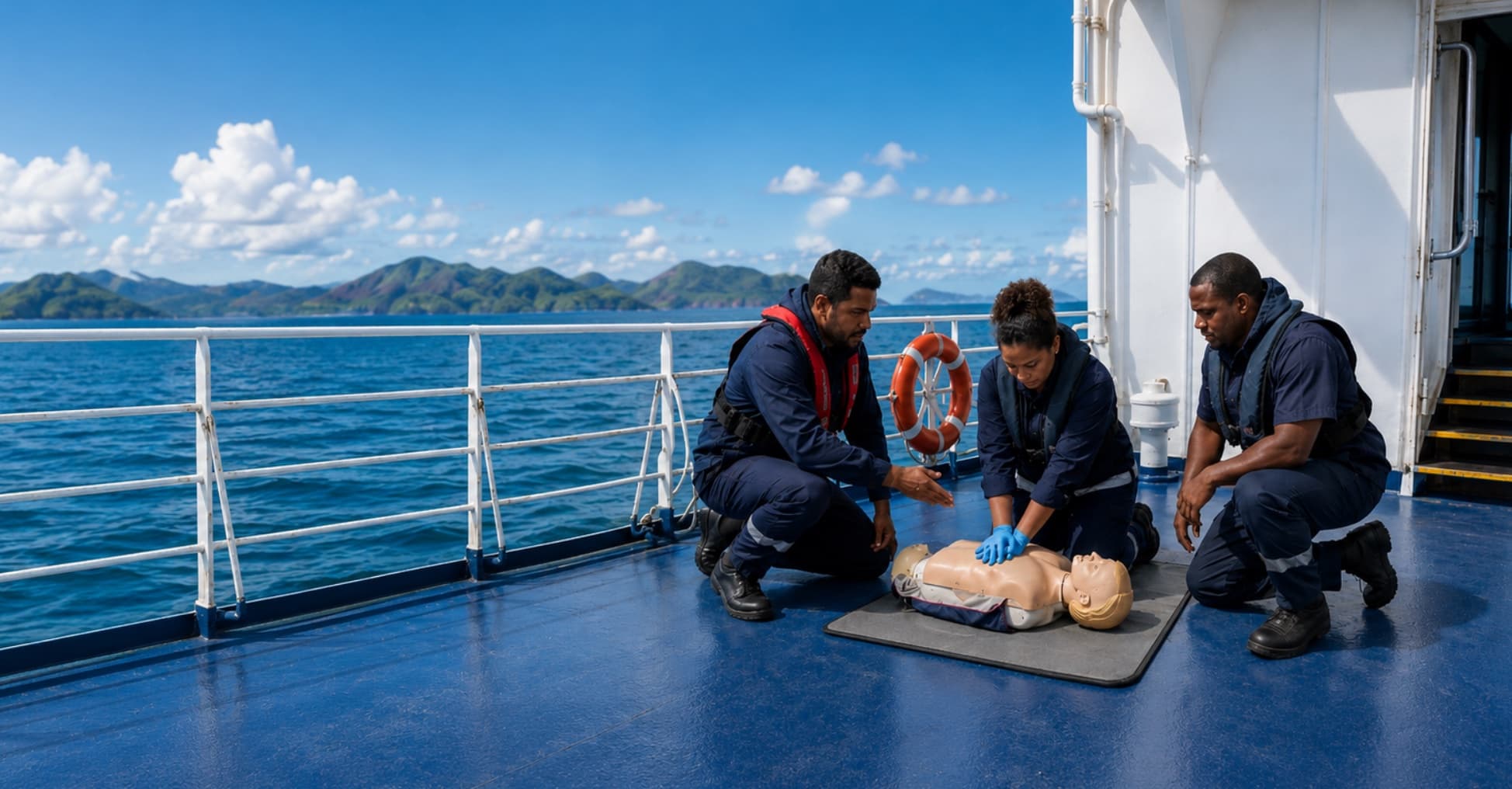
Course objectives
- Integrate effectively into a rescue chain in a maritime environment
- Carry out an assessment and report to the competent authorities (CROSS / CCMM)
- Ensure protection and safety during an intervention at sea
- Manage life-threatening emergencies with appropriate equipment
- Manage injuries and situations specific to the maritime environment
- Carry out lifting and stretcher-carrying in an unstable environment
- Intervene as a team in realistic operational situations
Who it is for
Audience
Personnel on board vessels; Professional seafarers; Ship crews; Nautical or maritime personnel
Prerequisites
Minimum age 16 Parental authorisation for minors
Format
Face-to-face training, in our training rooms in Jarry or directly at your premises. A combination of theoretical input and practical scenarios, using the centre's training equipment. People with disabilities are invited to inform us of their adaptation needs when registering.
Lead time
Registration is possible up to 48 hours before a scheduled session, subject to availability. For a session organised at your premises, allow approximately 15 days between your request and delivery.
Course content
Sequence 1: Organisation of rescue at sea
- Maritime rescue chain
- Role of the CROSS and the CCMM
- Role of the first aider on board
- Raising the alert
Sequence 2: Protection and safety
- Risk analysis in a maritime environment
- Personal protection
- Securing the area
- Emergency extrications
Sequence 3: Assessment and monitoring
- Circumstantial assessment
- Vital and secondary assessment
- Reporting the assessment
- Monitoring the casualty
Sequence 4: Life-threatening emergencies – cardiac arrest
- Recognising cardiac arrest
- Cardiopulmonary resuscitation
- Using the AED (defibrillator)
- Organisation with several responders
Sequence 5: Life-threatening emergencies – haemorrhage
- External and externalised haemorrhage
- Manual compression
- Pressure dressing
- Tourniquet
Sequence 6: Life-threatening emergencies – neurological
- Loss of consciousness
- Neurological assessment
- Appropriate waiting position
- Monitoring
Sequence 7: Life-threatening emergencies – respiratory
- Respiratory distress
- Airway obstruction
- Artificial ventilation
- Oxygen therapy
Sequence 8: Sudden illness and specific conditions
- Seizure
- Asthma attack
- Sudden illness of medical origin
- Action to take
Sequence 9: Injuries
- Wounds
- Burns
- Spinal injuries
- Limb injuries
- Immobilisation techniques
Sequence 10: Maritime-specific situations
- Immersion hypothermia
- Drowning
- Poisoning
- Management in an isolated environment
Sequence 11: Lifting and stretcher-carrying
- Lifting techniques
- Stretcher-carrying in an unstable environment
- Use of specific equipment (spinal board, splint, harness)
Sequence 12: Case studies and practical scenarios
- Realistic scenarios in a maritime environment
- Teamwork
- Stress management
- Operational coordination
Sequence 13: Certification assessment
- Continuous assessment
- PSE1 practical tests
- Validation of skills
Teaching team
The teaching team of the Centre National de Formation et de Prévention (CNFP) is made up of expert trainers and instructors with solid field experience and a thorough command of the regulatory frameworks applicable to their areas of expertise.
CNFP instructors are selected for their technical competence, their ability to pass on operational knowledge and their understanding of the professional realities of the trainees they teach.
The teaching team is engaged in an ongoing process of improving practices, monitoring regulations and adapting content in order to guarantee the quality, relevance and effectiveness of training activities.
Monitoring and assessment
The PSE1 certification pass rate is monitored at each session and is regularly analysed.
Trainee satisfaction is measured through end-of-course questionnaires.
Attendance is also monitored through attendance sheets.
These indicators make it possible to assess the quality of the training and, where necessary, to undertake continuous improvement actions.
Technical and teaching resources
Adult / child / infant manikins
Training AEDs (defibrillators)
Complete first-aid equipment
Oxygen therapy equipment
Simulation equipment
Digital training materials
Certification
Assessment
Attendance sheets
Ongoing formative assessments
Practical scenarios
PSE1 certification tests
Certification
PSE1 team first aid certificate of competence issued by UNASS (subcontracted)
PSEM training certificate – CNFP
Quality and results
Indicators specific to this course, as at 10 September 2026: 12 satisfaction reviews collected at the end of this course, average score of 9.3/10; assessment pass rate of 100.0% (7 passes out of 7 trainees assessed).
Across the centre, from 30 January to 10 September 2026: 112 satisfaction reviews collected from trainees, average score of 9.30/10, of which 92.9% were scores of 8/10 or higher; assessment pass rate of 97.3% (181 passes out of 186 trainees assessed).
These indicators are updated after each session and are available on request.
Accessibility
CNFP considers every adaptation request in order to facilitate access to training for people with disabilities. A preliminary discussion makes it possible to assess needs and to consider, where possible, adapted arrangements.
Our disability lead reviews every request for adjustments: handicap@cnfp.fr
Interested in this course?
Session at your premises, dates to suit you, group size adapted.