
Course objectives
- Maintain and update the operational skills of first aid team members holding the PSE2
- Refresh the procedures to follow in emergency situations
- Strengthen proficiency in technical procedures and team-based casualty care
- Incorporate regulatory and technical developments in first aid
- Ensure operational fitness within pre-planned first aid cover (DPS)
Who it is for
Audience
Holders of a valid PSE2; First aiders engaged with an approved civil protection association; Professionals or volunteers involved in rescue and first aid to persons
Prerequisites
Hold the PSE2
Format
Face-to-face training, in our rooms in Jarry or directly on your premises. A combination of theoretical input and practical scenarios, using the centre's training equipment. People with disabilities are invited to inform us of their adaptation needs when registering.
Lead time
Registration is possible up to 48 hours before a scheduled session, subject to availability. For a session organised on your premises, allow approximately 15 days between your request and delivery.
Course content
Updating regulatory and operational knowledge
- Regulatory reminders and changes to the standards
- Role, responsibilities and scope of intervention of the PSE2 holder
- Organisation of emergency response and operation of first aid arrangements (DPS, chain of survival)
Sequence 2: Management of life-threatening emergencies
- Cardiac arrest: team CPR and use of the AED (defibrillator)
- Respiratory distress and airway management
- External haemorrhage and associated situations
Sequence 3: Management of trauma and specific emergencies
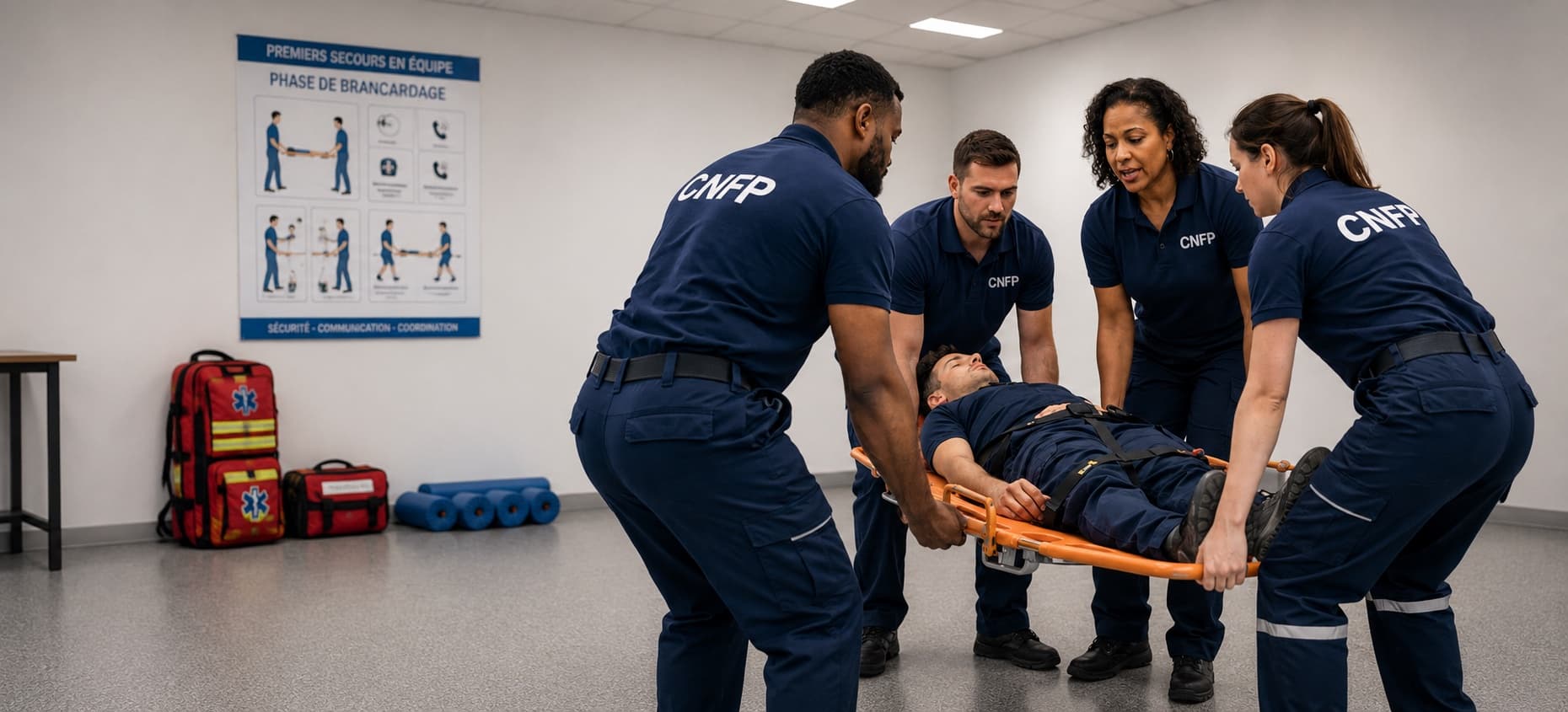
- Trauma: immobilisation, lifting and packaging
- Sudden illness and specific conditions (neurological, metabolic…)
- Monitoring and reassessment of the casualty
Sequence 4: Operational techniques and first aid equipment
- Use of oxygen therapy
- Handling of immobilisation and lifting equipment
- Stretcher-carrying and transport techniques
Sequence 5: Teamwork and incident management
- Team coordination and communication
- Scene safety and management of the environment
- Allocation of roles and decision-making
Sequence 6: Operational scenarios
- Complete team-based practical cases
- Realistic scenarios with field constraints
- Technical debrief and areas for improvement
Teaching team
The teaching team of the Centre National de Formation et de Prévention (CNFP) is made up of expert trainers and contributors with solid field experience and a thorough command of the regulatory frameworks applicable to their areas of expertise.
CNFP contributors are selected for their technical competence, their ability to pass on operational knowledge and their understanding of the professional realities of the trainees they train.
The teaching team is committed to an ongoing process of improving practices, monitoring regulations and adapting content in order to guarantee the quality, relevance and effectiveness of training courses.
Monitoring and assessment
Trainee satisfaction rate, skills validation pass rate, attendance rate, recommendation rate and monitoring of quality feedback with a view to continuous improvement.
Technical and teaching resources
First aid manikins (adult, child, infant)
Training defibrillators
Immobilisation and lifting equipment
Oxygen therapy kits
Training materials compliant with national standards
Certification
Assessment
Attendance sheets (managed by the approved association)
Continuous assessment during practical exercises
Validation of technical and behavioural skills
Pre-course placement questionnaire (carried out by CNFP)
Satisfaction questionnaire at the end of the training
Certification
This continuing training maintains the validity of the PSE2, a certification issued by an approved civil protection association, in accordance with the regulations in force.
Quality and results
New course: the first indicators specific to this course will be published after the first sessions.
Across the centre, from 30 January to 10 September 2026: 112 satisfaction reviews collected from trainees, average score of 9.30/10, with 92.9% of scores greater than or equal to 8/10; assessment pass rate of 97.3% (181 passes out of 186 trainees assessed).
These indicators are updated after each session and provided on request.
Accessibility
CNFP considers every adaptation request in order to facilitate access to training for people with disabilities. A preliminary discussion makes it possible to assess needs and to consider, where possible, adapted arrangements.
Our disability lead reviews every request for adjustments: handicap@cnfp.fr
Interested in this course?
Session at your premises, dates to suit you, group size adapted.