
Course objectives
- Identify the fundamental principles of fire (the fire triangle) and the main classes of fire encountered in the workplace.
- Recognise the different types of extinguishers (water, water + additive, CO₂, powder) and choose the extinguishing method suited to the situation.
- Apply safety and alert instructions in the event of an outbreak of fire in an establishment or on a work site.
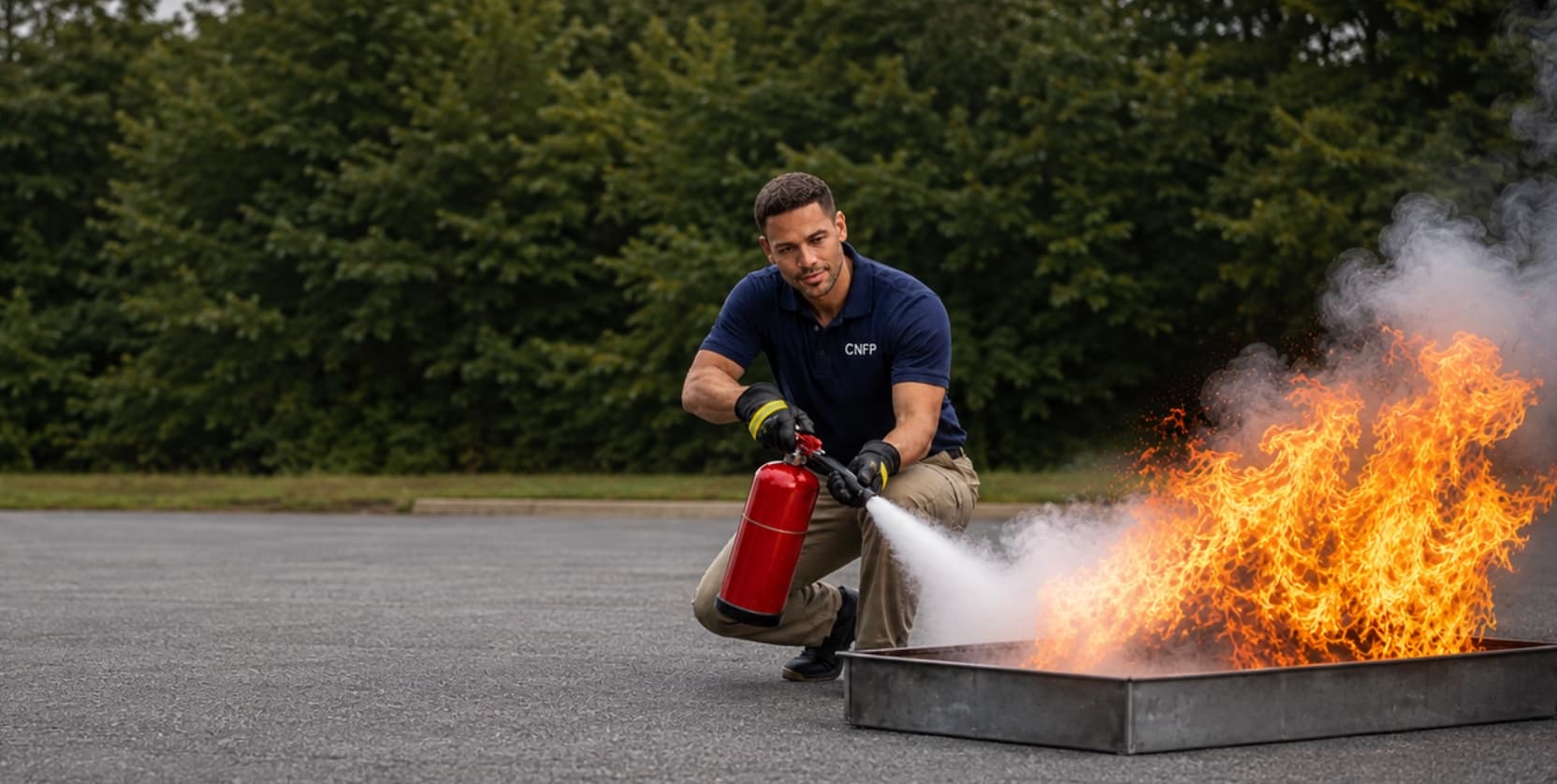
- Carry out extinguishing on a real or simulated fire, following fire attack techniques and self-protection rules.
- Adopt appropriate behaviour when faced with an outbreak of fire, assessing the limits of human intervention and the need
- for evacuation.
Who it is for
Audience
Company employees (all sectors of activity). ; Staff of local authorities and public bodies. ; Staff working in establishments open to the public (ERP). ; Self-employed workers and business owners.
Prerequisites
No technical or regulatory prerequisites are required. ; Understanding of spoken French recommended.
Format
Face-to-face training, in our training rooms in Jarry or directly on your premises. A combination of theory and practical scenarios, using the centre's training equipment. People with disabilities are invited to inform us of their adaptation needs when registering.
Lead time
Registration is possible up to 48 hours before a scheduled session, subject to availability. For a session held on your premises, allow approximately 15 days between your request and delivery.
Course content
Fire risk awareness
- Principles of fire and the fire triangle
- Common causes of fire in the workplace
- Human, material and organisational consequences
Firefighting equipment
- Classes of fire (A, B, C, D, F)
- Types of extinguishers and extinguishing agents
- Choosing the extinguishing method suited to the fire
Safety rules and procedures to follow
- Raising the alert and the alarm
- Safety rules before any intervention
- Limits of intervention by a first witness
Extinguisher handling (practical scenarios)
- Presentation of and familiarisation with the equipment
- Technical fire attack techniques
- Practical exercises on a real fire or simulator
Summary and assessment
- Debriefing of the scenarios
- Practical assessment of learning
- Review of essential prevention instructions
Teaching team
- Delivery of the course is subject to formal monitoring to ensure the effective participation of trainees and the smooth running of the training.
- Monitoring of delivery is ensured by:
- Attendance sheet signed by the trainees and the trainer (per half-day)
- Attendance checks during the theory and practical sequences
- Monitoring of training time in line with the planned programme
- Traceability of training via the Digiforma platform
- At the end of the course, each participant receives a CNFP training certificate specifying the nature, the duration and the skills covered.
Monitoring and assessment
- The quality indicators of the course are measured on the basis of:
- the trainees' participation and attendance rate,
- the results of the practical assessments at the end of the course,
- trainee feedback via an end-of-course satisfaction questionnaire,
- the trainer's observations during the scenarios.
- These indicators make it possible to assess whether the learning objectives have been achieved and to continuously improve the course content and methods.
Technical and teaching resources
CNFP training materials (presentation, quick-reference sheets)
Training extinguishers and demonstration equipment
Secure exercise area / fire simulator
PPE
Certification
Assessment
Formative assessment during practical scenarios
Observation of technical skills and compliance with safety instructions
Oral questions to validate knowledge
End-of-course trainee satisfaction questionnaire
Certification
This course does not lead to a certification registered with the RNCP or the Répertoire Spécifique. It leads to the issue of a CNFP training certificate – Fire Extinguisher Handling, stating the duration, the objectives and the skills covered.
Quality and results
Indicators specific to this course, as at 10 September 2026: 4 satisfaction reviews collected at the end of this course, average score of 10.0/10; assessment pass rate of 100.0% (4 passes out of 4 trainees assessed).
Across the centre, from 30 January to 10 September 2026: 112 satisfaction reviews collected from trainees, average score of 9.30/10, of which 92.9% were scores of 8/10 or above; assessment pass rate of 97.3% (181 passes out of 186 trainees assessed).
These indicators are updated after each session and provided on request.
Accessibility
CNFP pays particular attention to welcoming people with disabilities.
Any specific request relating to a disability is assessed individually in order to adapt, as far as possible, the teaching, material or organisational arrangements of the course.
For any information or request for adjustments, participants are invited to contact the CNFP disability officer before the course.
Our disability lead reviews every request for adjustments: handicap@cnfp.fr
Interested in this course?
Session at your premises, dates to suit you, group size adapted.