
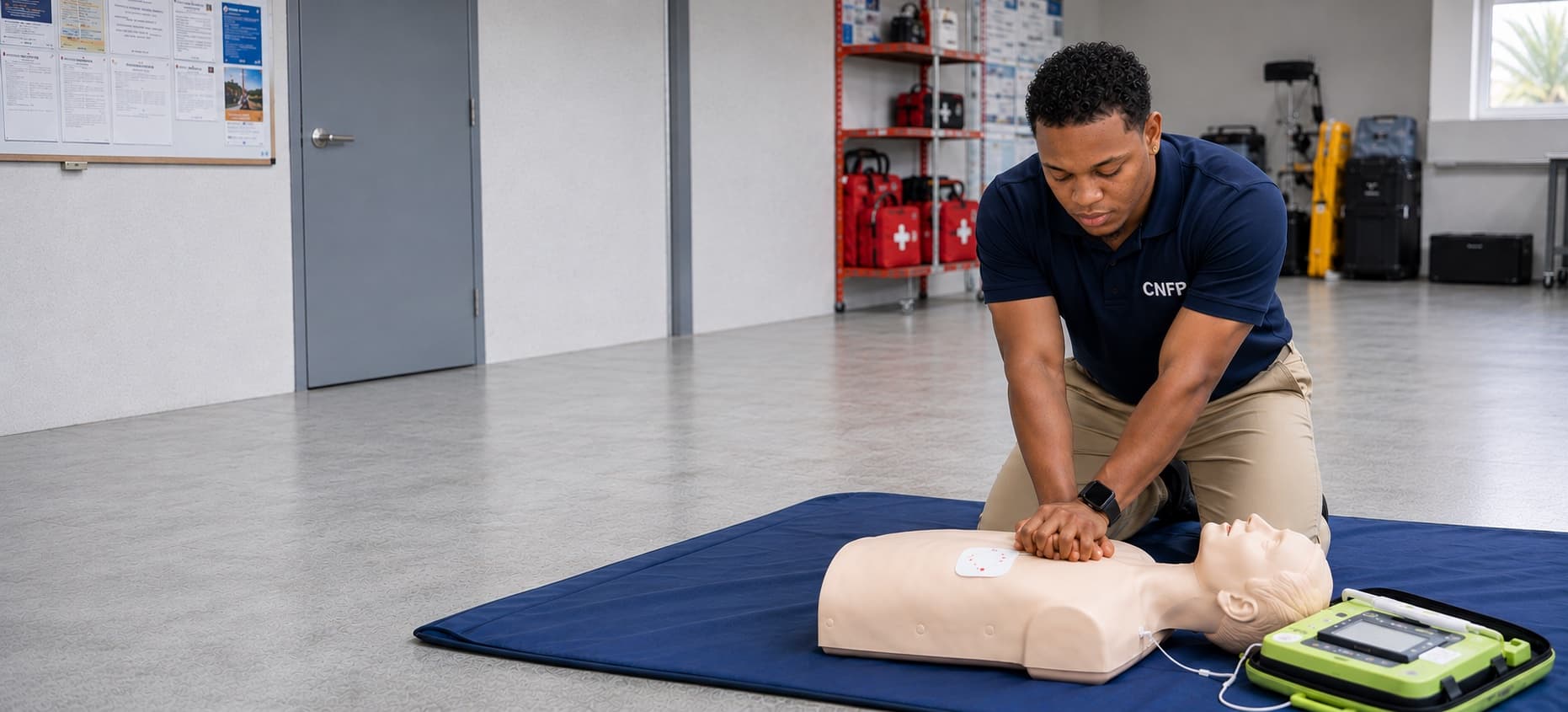
Course objectives
- Identify an emergency situation in the workplace
- Implement appropriate protective measures
- Raise the alarm effectively
- Carry out first-aid actions for a conscious or unconscious casualty
- Act effectively while awaiting the arrival of the emergency services
Who it is for
Audience
Company employees, all sectors; Staff and employees of local authorities; Supervisors, managers and team leaders; Staff in contact with the public (public-access buildings, reception, retail, services); New recruits or staff who have never been trained in first aid
Prerequisites
No prerequisites are required to attend this course.
Format
Face-to-face training, in our training rooms in Jarry or directly on your premises. A combination of theory and practical scenarios, using the centre’s training equipment. People with disabilities are invited to inform us of any adjustments they need when registering.
Lead time
Registration is possible up to 48 hours before a scheduled session, subject to availability. For a session held on your premises, allow approximately 15 days between your request and delivery.
Course content
Understanding the issues and the framework for intervention
- Emergency situations in the workplace
- Protecting yourself, the casualty and others
- Raising the alarm and organising the emergency response
Assisting a casualty
- Caring for a conscious casualty
- Caring for an unconscious casualty
- Waiting positions and monitoring
Responding to life-threatening emergencies
- External bleeding
- Airway obstruction (choking)
- Loss of consciousness and cardiac arrest
Teaching team
The course is delivered by a trainer authorised to teach first aid, holding the current regulatory certifications and with significant operational experience in first aid and risk prevention.
The trainer has teaching expertise enabling them to adapt learning methods to trainees’ profiles, favouring an active, participatory and practice-oriented approach.
The teaching team is placed under the responsibility of the organisation’s head of training, who guarantees regulatory compliance, the quality of the content and adherence to Qualiopi requirements.
Monitoring and assessment
This course is subject to educational and quality monitoring to assess attendance, trainees’ learning and their satisfaction, with a view to the continuous improvement of training activities.
Technical and teaching resources
Projected training materials (visual presentations)
Adult and child first-aid manikins
Simulation equipment (training defibrillator, first-aid accessories)
Summary practical sheets on life-saving actions
Certification
Assessment
Digital attendance register for participants
Practical scenarios based on real-life cases
Oral questioning to confirm understanding of the essential actions
Ongoing formative assessment throughout the session
Certification
This course does not lead to a professional certification registered with the RNCP or the Répertoire Spécifique. It leads to the issue of a “Gestes Qui Sauvent” training certificate, in line with the national guidelines on first-aid awareness.
Quality and results
Indicators specific to this course, as at 10 September 2026: 37 satisfaction reviews collected at the end of this course, average score of 9.4/10; assessment pass rate of 100.0% (9 passes out of 9 trainees assessed).
Across the centre, from 30 January to 10 September 2026: 112 satisfaction reviews collected from trainees, average score of 9.30/10, of which 92.9% were scores of 8/10 or higher; assessment pass rate of 97.3% (181 passes out of 186 trainees assessed).
These indicators are updated after each session and are available on request.
Accessibility
The course is accessible to people with disabilities.
Any specific request for teaching or equipment adjustments can be considered before the course.
A disability officer is available to support trainees.
Our disability lead reviews every request for adjustments: handicap@cnfp.fr
Interested in this course?
Session at your premises, dates to suit you, group size adapted.